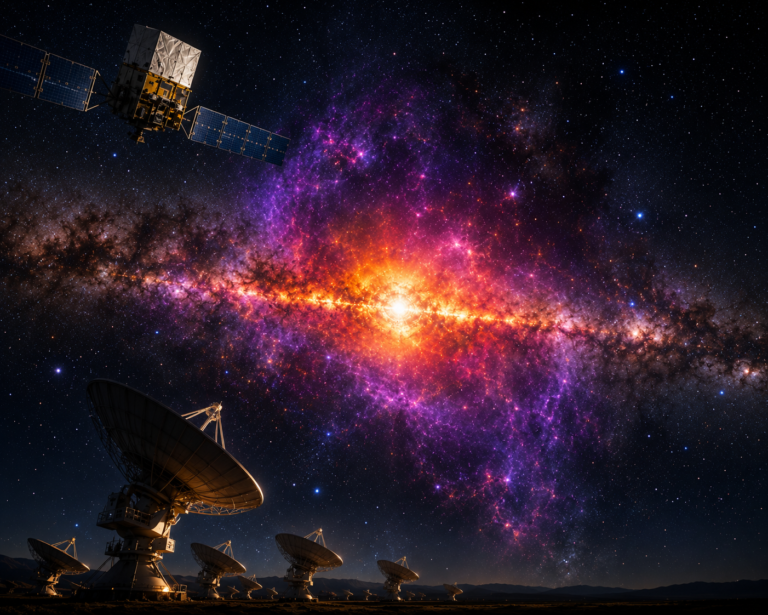
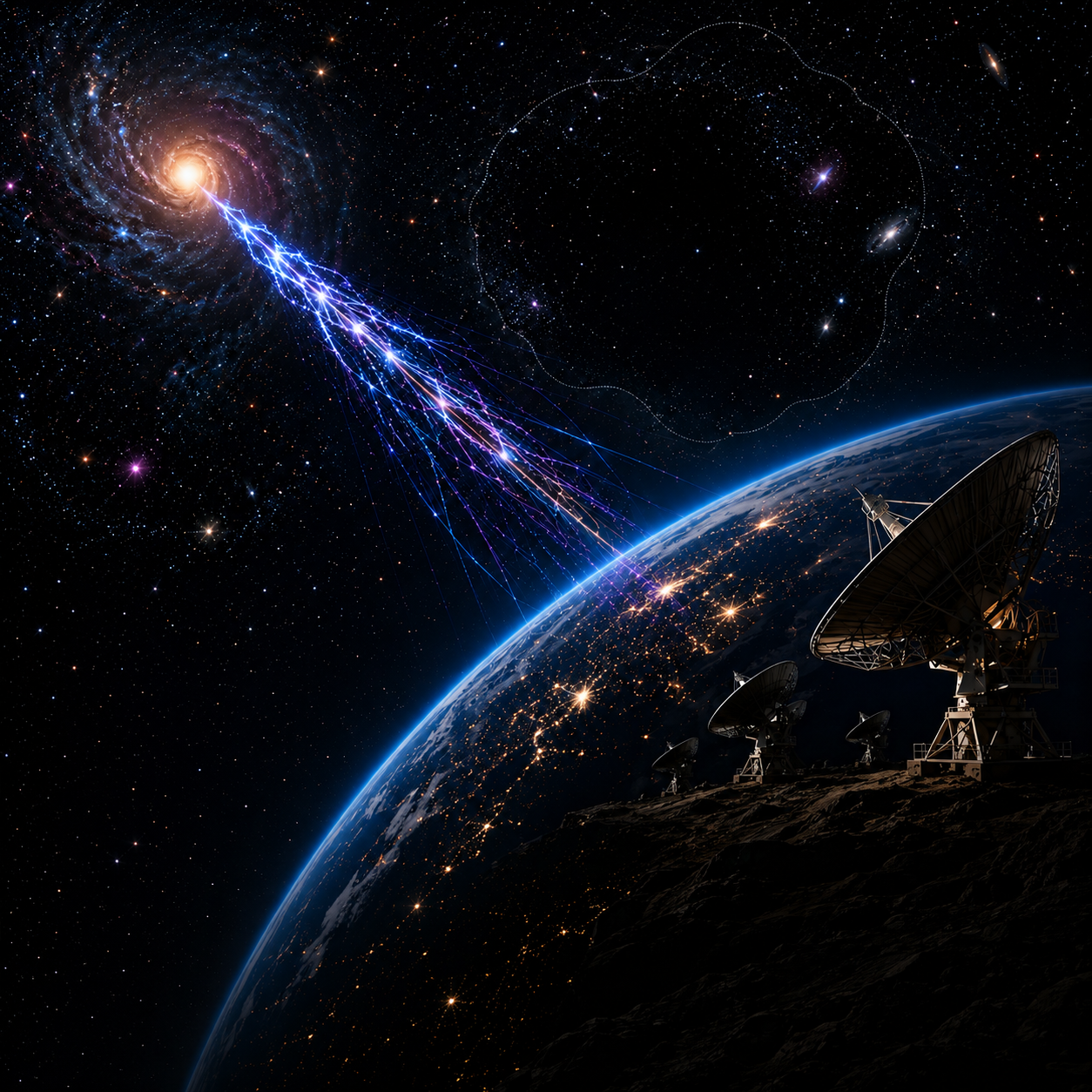

Astronomers are investigating a fascinating cosmic mystery after some of the most energetic particles ever detected appear to originate from a region of space that should, by all accounts, be nearly empty.
The puzzle centers on ultra-high-energy cosmic rays—subatomic particles that travel across the universe at speeds approaching the speed of light while carrying enormous amounts of energy. These particles are so powerful that a single atomic nucleus can contain the same kinetic energy as a fast-thrown baseball despite being billions of times smaller.
Recent analyses have traced several of these extraordinary events back toward a vast region known as the Local Void, an enormous expanse of space containing very few galaxies, stars, or other visible structures. The mystery gained additional attention after the detection of the famous Amaterasu particle, an ultra-high-energy cosmic ray carrying more than 240 exa-electron volts of energy, which also appeared to arrive from the direction of this seemingly empty region.
Under current astrophysical theories, particles with such extreme energies are expected to originate from some of the universe’s most powerful environments. Potential sources include supermassive black holes, active galactic nuclei, powerful jets emitted by galaxies, and catastrophic stellar explosions. Yet astronomers have not identified any obvious objects capable of producing these particles in the direction of the Local Void.
This apparent contradiction has sparked intense scientific interest. One possibility is that the particles did not actually originate within the void itself. Because cosmic rays are electrically charged, their paths can be altered by magnetic fields encountered during their journey through space. These magnetic deflections may cause particles to appear as though they came from a completely different region of the sky.
Other researchers are exploring whether hidden structures, undiscovered galaxies, or previously unknown astrophysical processes could exist within or beyond the Local Void. Some scientists speculate that the mystery may point to extreme cosmic phenomena that are not yet fully understood.
Importantly, researchers are not suggesting that these particles are violating the laws of physics or traveling faster than light. Instead, the challenge is explaining how they achieved such extraordinary energies and why their apparent origin points toward a region where no suitable accelerator has yet been found.
As next-generation observatories continue collecting data, astronomers hope to determine whether the Local Void is merely an illusion created by magnetic fields—or whether it is hiding one of the universe’s most powerful and mysterious particle accelerators.
If confirmed, the discovery could reshape our understanding of cosmic rays, the large-scale structure of the universe, and the extreme processes that operate in the deepest reaches of space.