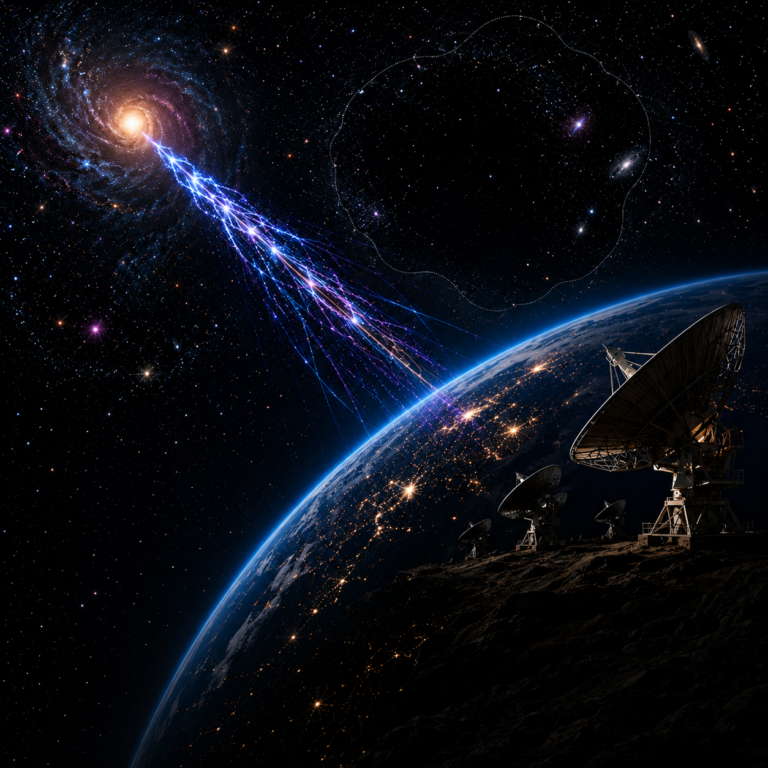
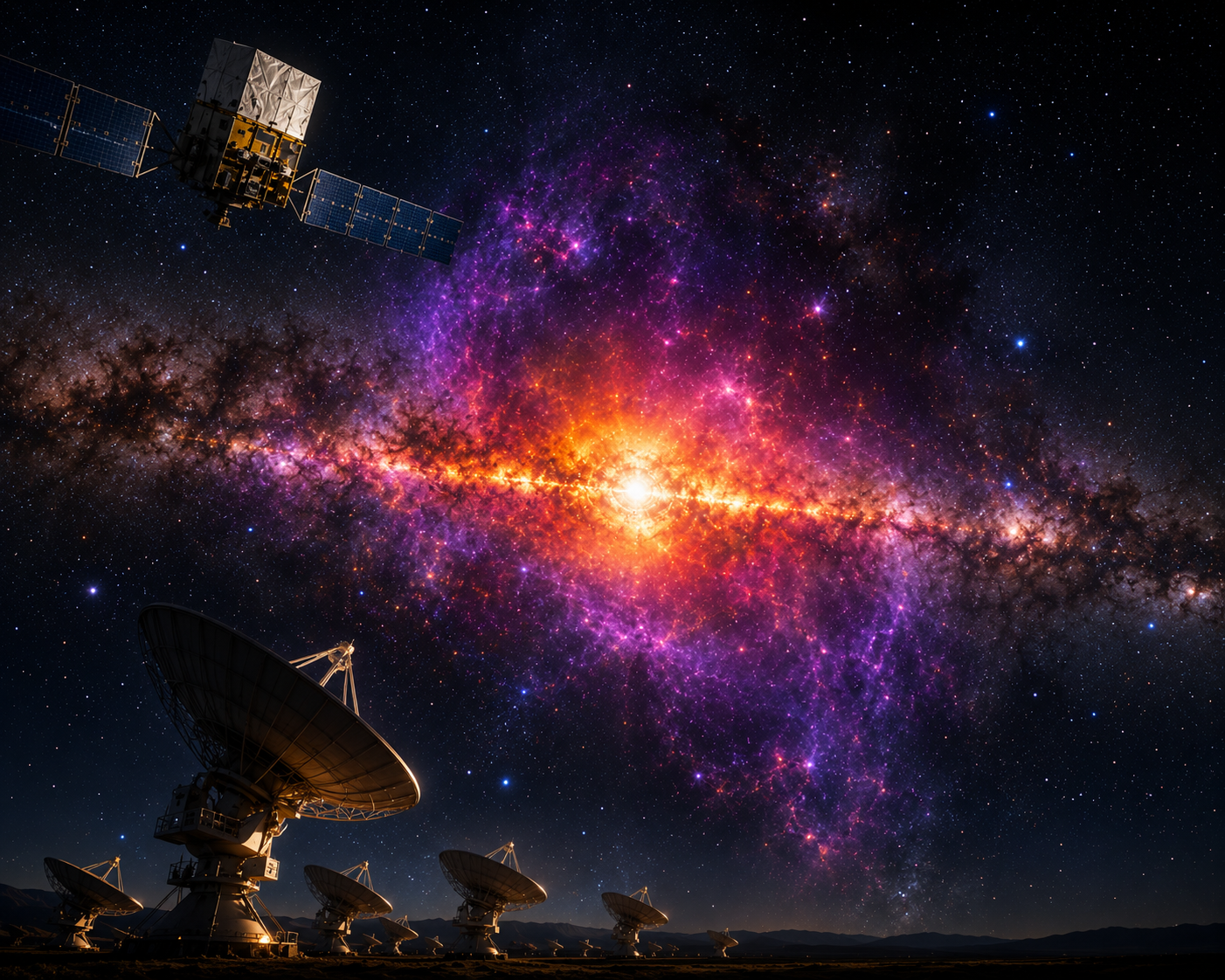

For nearly fifteen years, astronomers have been investigating a mysterious source of high-energy radiation emanating from the center of our galaxy. Observations from NASA’s Fermi Gamma-ray Space Telescope revealed an enormous cloud of gamma rays stretching thousands of light-years outward from the Milky Way’s core, a phenomenon known as the Galactic Center Excess.
Despite years of study, the true source of this unusual glow has remained one of the most debated questions in modern astrophysics.
For much of the past decade, the leading explanation pointed to a hidden population of pulsars—rapidly rotating neutron stars capable of producing powerful gamma-ray emissions. Because these objects would be extremely faint and densely packed near the galactic center, researchers suggested they might collectively create the observed signal without being individually detectable.
A new study, however, has challenged that long-standing interpretation.
Using advanced machine-learning techniques, researchers created highly detailed simulations of gamma-ray source distributions within the Milky Way. Their analysis found that the smooth and diffuse nature of the Galactic Center Excess appears to align more closely with predictions associated with dark matter particle annihilation than with a population of unresolved pulsars.
Dark matter remains one of the greatest mysteries in science. Although it is believed to account for approximately 85 percent of all matter in the universe, it neither emits nor reflects light, making it invisible to conventional telescopes. Scientists infer its existence through its gravitational effects on galaxies, galaxy clusters, and the large-scale structure of the cosmos.
Some theoretical models propose that when dark matter particles encounter one another, they may annihilate and release detectable bursts of energy, including gamma rays. If the Galactic Center Excess is indeed the result of such interactions, it could provide one of the strongest indirect pieces of evidence yet discovered for the existence of dark matter.
The implications would be profound. Confirming a dark matter signal would help researchers narrow down the properties of these elusive particles and bring science closer to solving one of the most fundamental questions about the composition of the universe.
However, astronomers emphasize that the case is far from settled. Alternative explanations remain viable, and additional observations will be needed to determine whether dark matter, pulsars, or another unknown process is responsible for the mysterious glow.
For now, the findings have reignited one of astronomy’s most significant debates. What began as an unexplained gamma-ray signal has evolved into a potential clue about the invisible matter that shapes galaxies and influences the evolution of the universe itself.
As future observatories and analytical techniques continue to improve, the glow at the center of the Milky Way may ultimately reveal whether scientists are observing a hidden population of exotic stars—or the long-sought fingerprints of dark matter.